Morning Cortisol, Protein, and Staying Sharp Through Long Days in the Woods
Every deer hunter knows the rhythm of the season.
Alarms go off long before daylight. Coffee gets poured half asleep. Boots go on in the dark. You step outside into cold air, anticipation already running high. For many hunters, food is an afterthought — maybe something quick, maybe nothing at all.
By mid-morning, the problems show up: shaky energy, loss of focus, or a hard crash. By late season, some hunters notice another pattern — weight creeping on during a time when they’re actually more active.
This isn’t a discipline issue.
It’s physiology — specifically how your body handles stress hormones and fuel first thing in the morning.
Cortisol: A Hormone Hunters Rely On (and Often Overload)
Cortisol is your body’s primary alert and stress hormone. It helps you wake up, stay focused, mobilize stored energy, and respond to physical stress. Hunters need cortisol — it’s part of what keeps you sharp before first light and steady in cold conditions.
Under normal circumstances, cortisol rises naturally after waking and tapers throughout the day.
Hunters, however, stack cortisol triggers early: very early alarms, cold exposure, mental anticipation, caffeine, and long periods of stillness. When that cortisol rise happens without adequate fuel, the body may interpret the situation as stress plus uncertainty.
“From a survival standpoint, stress without fuel leads to conservation — storing energy and driving hunger later.”
Where the 30-30-30 Idea Comes From
The “30-30-30” concept — often attributed online to Tim Ferriss and promoted by Gary Brecka — is not a proven clinical protocol. There are no large trials validating the exact numbers.
What is supported are the components:
- protein early improves satiety and appetite regulation
- amino acids support muscle repair and recovery
- gentle movement adds activity without compounding stress
For deer hunters, the value isn’t “fat burning.”
It’s energy control and recovery during long, demanding days.
What the Science Actually Supports (Plain Language)
Research on protein metabolism shows that dietary protein is broken down into amino acids used for tissue repair, enzymes, hormones, and — during prolonged effort — energy support. Amino acids contribute to maintaining blood glucose and limiting excessive muscle breakdown during sustained activity.
Studies on essential amino acids (EAAs) show they can stimulate muscle protein synthesis and satellite cell activity, particularly after physical stress. Satellite cells are essential for muscle repair — a big deal for hunters covering rough terrain, dragging deer, or stacking long days.
Key takeaway box (Callout):
Protein = foundation for satiety and stability
EAAs = support tool for repair when intake is low
EAAs amplify repair signals, but they do not replace whole-food protein for fullness and overall energy regulation.
What Hunters Report When They Apply This
(Anecdotal field experience — not clinical data)
“Coffee-only mornings always left me shaky by mid-morning. Eggs or a shake before heading out made a noticeable difference on long sits.”
“Once I added protein early, I stopped snacking out of boredom by 10 or 11.”
“Recovery between days improved once I paid attention to protein — especially after long walks and hill climbs.”
Not everyone loves eating early. Many hunters ease into it gradually.
Hunter-Friendly Breakfasts That Actually Work
The most common mistake is assuming “a little protein” is enough. One egg or a bite of jerky won’t meaningfully change the signal.
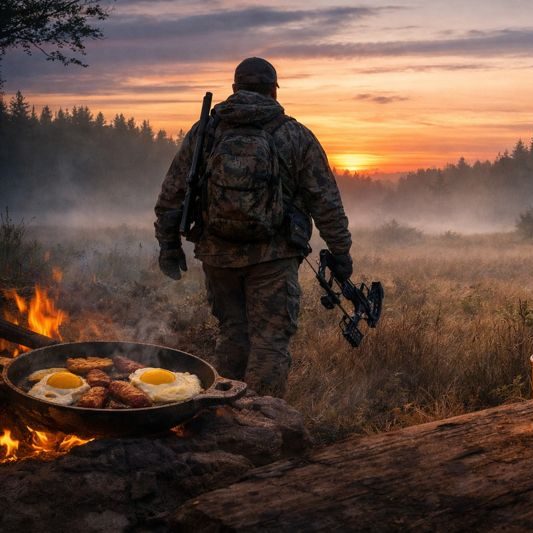
Camp mornings often work best with venison sausage and eggs in a skillet — simple, filling, and cold-weather friendly.
Truck mornings favor convenience: a whey isolate protein shake delivering ~25–30 grams of protein in under a minute.
No-cook mornings can work with high-protein Greek yogurt or cottage cheese (check labels).
Egg-based approach: four whole eggs, or eggs plus egg whites, to reach a meaningful protein dose.
Jerky tip: great addition — rarely enough on its own.

Protein-first camp breakfasts don’t need to be complicated — the goal is fuel before stress.
Where Perfect Aminos Fit (and Where They Don’t)
Perfect Aminos are an essential amino acid (EAA) supplement produced by BodyHealth. EAAs provide amino acids directly, without digestion.
Customer reviews often describe them as easy to tolerate early and useful on days when appetite is low. Some users report less soreness during physically demanding periods.
Perfect Aminos do not replace eating ~30g of protein.
They do not provide the satiety or caloric support of whole food protein.
Where they may make sense for hunters:
- very early mornings when food is hard to get down
- as a bridge until real food later
- as recovery support during heavy activity
Why Amino Acid Utilization Matters More Than “Protein Grams”
PerfectAmino is built around a simple idea most protein discussions miss: utilization matters more than quantity.
Traditional protein powders must be digested and broken down into amino acids before the body can use them. In the process, excess amino acids that aren’t needed for muscle repair or tissue building are metabolized for energy — contributing to unnecessary calories, blood sugar swings, and fat storage.
PerfectAmino bypasses that inefficiency by supplying only essential amino acids, in ratios the human body already uses to build new protein and collagen. Because there’s no excess and no filler, nearly all of it can be directed toward protein synthesis rather than waste.
That’s why PerfectAmino provides the protein-building equivalent of a full serving of whey, while adding virtually no caloric load — and why it doesn’t interfere with intermittent fasting.
Taken 20–30 minutes before training, these amino acids can be fully available in the bloodstream as your workout begins, supporting endurance, recovery, and muscle preservation in real time.
PerfectAmino is:
- 100% Vegan
- Non-GMO
- Gluten-Free
- Sugar-Free
For anyone trying to get leaner without sacrificing strength — or preserve muscle while fasting — it offers a cleaner, more efficient alternative to traditional protein powders.
Product information:
Perfect Aminos on Amazon
Coffee Timing (No One’s Asking You to Quit)
Coffee is part of hunting culture. A simple tweak many hunters find helpful is not starting with coffee alone. Protein first — or after a few minutes of movement — often leads to steadier energy later.
Optional. Not mandatory.
A Realistic 7-Day Hunting-Season Experiment
Try this for one week:
eat a protein-focused breakfast most mornings, move naturally before settling in, and save sugar for later in the day.
Pay attention to energy, hunger, focus, and recovery.
Keep what helps. Drop what doesn’t.
What This Is — and What It Isn’t
This is not a fat-loss guarantee or a rigid rulebook.
It is a practical way to manage early-morning stress and energy.
“The 30-30-30 idea doesn’t magically burn fat — it helps prevent your body from misreading early-morning stress as a reason to conserve and store energy.”
For deer hunters living in the dark, the cold, and the early hours, that small shift can change the entire day.
As an Amazon Associate, Big Buck Registry earns from qualifying purchases.
Leave a Reply