Poaching isn’t hunting. It’s theft of a public wildlife resource — and it hurts the animals on the landscape, the conservation dollars that manage them, and the reputation of lawful hunters who do things the right way.
That’s why the Boone and Crockett Club launched its Poach & Pay effort: to put real numbers behind a problem that’s easy to underestimate because most of it happens out of sight.
Poaching is a “cryptic crime”: most of it stays hidden
Poaching doesn’t usually happen where witnesses are standing around. It happens late, remote, and quiet — and that reality shows up in the research.
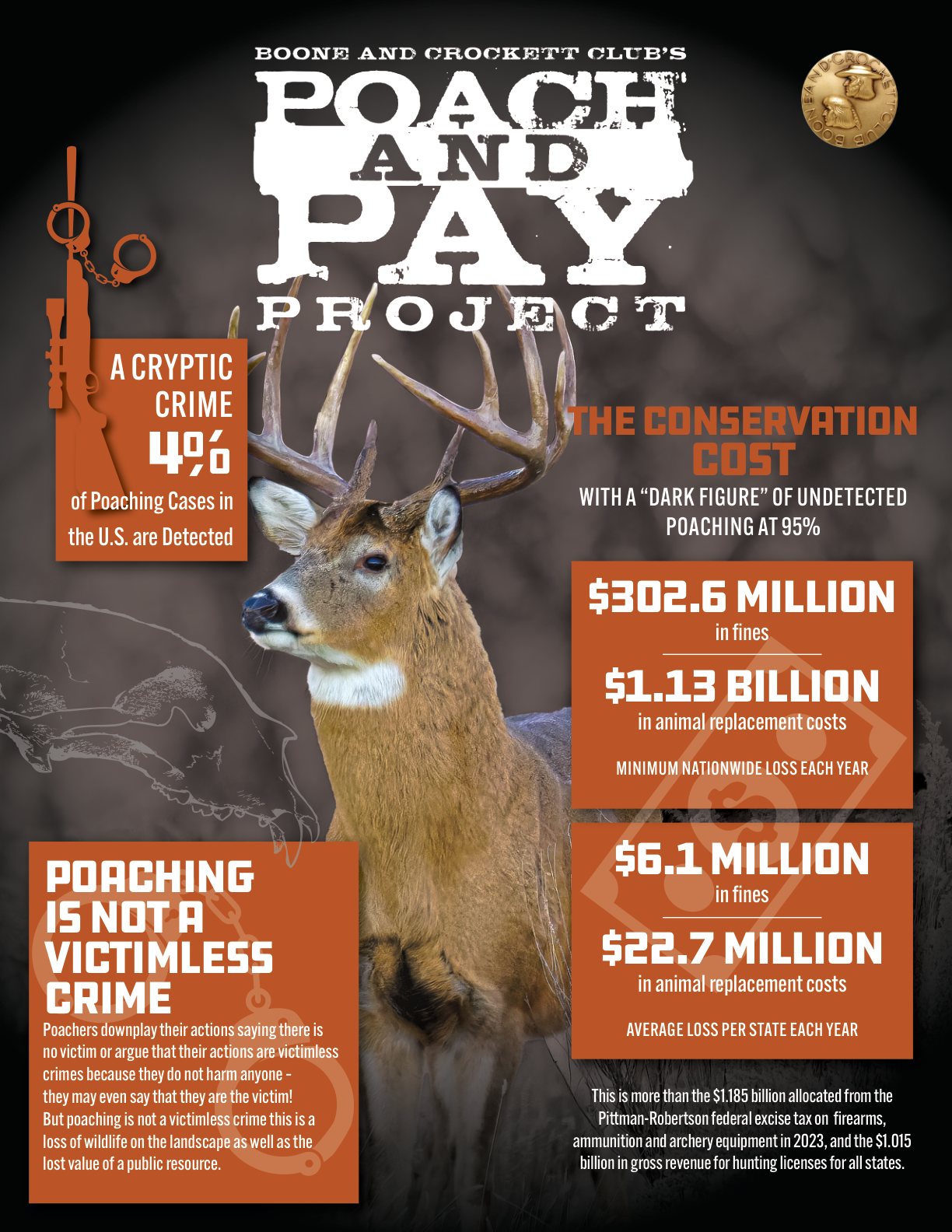
Poach & Pay estimates that the average detection rate for big-game poaching is about 4.3% (with a credible range roughly 3.3% to 5.3%). In plain English: the “dark figure” — the part that never gets caught — is enormous.
That’s why this matters. When a poaching case makes the news, it can feel like the whole story. It isn’t. It’s a snapshot.
When poaching is rarely detected, the damage to wildlife—and to conservation funding—adds up fast.
The conservation cost isn’t just the animal
A poached deer (or elk, moose, bear, etc.) is already a loss. But the damage doesn’t stop there.
Poach & Pay uses a conservative benchmark of 5% detection to estimate the minimum annual losses tied to illegal big-game take. At that level, the research estimates:
- $302.6 million in fines (minimum) lost/never assessed each year
- $1.13 billion in animal replacement costs (minimum) lost/never assessed each year
- A combined minimum total of about $1.44 billion annually
On average, that works out to roughly $6.1 million in fines + $22.7 million in replacement costs per state each year (again, minimums).
And here’s the gut-punch comparison: those conservation losses are bigger than major nationwide conservation funding streams that hunters and anglers depend on.
Who poaches — and why it isn’t “one type of person”
One reason poaching is hard to fight is because it doesn’t come from one motive.
Poach & Pay identifies multiple poacher types, including:
- Trophy poachers
- Commercial poachers
- Subsistence poachers
- “Backdoor” poachers
- Recreational poachers
- Protective poachers
- Tradition / protest poachers
- Challenge poachers
- Thrill-kill poachers
Different motives require different pressure points — but the outcome is the same: wildlife stolen from the public.
What actually deters poaching?
A huge takeaway from this work is that the usual penalties aren’t always the most effective deterrents — especially for repeat offenders.
In the research, prosecutors pointed to two tools that matter most for reducing repeat poaching:
- Confiscation of equipment used in the crime
- Suspension or revocation of hunting privileges
That lines up with what a lot of hunters already believe: if someone is truly a poacher, a fine alone can feel like a “cost of doing business.” Losing gear and losing privileges hits harder.
The research also highlights a common-sense framing that matters in court and in public opinion: serious poaching is theft of a public resource, not a harmless “game violation.”
Solutions that actually move the needle
Poach & Pay points toward practical actions that make a difference:
- More boots on the ground (law enforcement coverage matters)
- Easier ways to report (anonymous tip lines and reporting pathways)
- Stronger case support (education for prosecutors and staff about wildlife crime)
- Better public education (so people stop lumping poaching in with hunting)
- Consistent replacement costs that are defensible and fair
- Reclassifying serious wildlife crimes from misdemeanors to felonies where appropriate
- Reciprocal license suspensions across states (so losing privileges in one state follows the offender)
What hunters can do right now
You don’t have to be a game warden to help.
- Report it when you see it (don’t confront; document what you can safely)
- Share tip-line info with camp members and landowners
- Talk about the difference between lawful hunting and poaching when the topic comes up
- Support conservation officers and enforcement funding in your state
- Back penalties that actually deter repeat offenders, not just wrist slaps
Most importantly, keep saying the part that needs to be said plainly:
Hunters are not poachers — and we don’t tolerate poaching.
Poach & Pay (Boone and Crockett Club):
https://www.boone-crockett.org/poach-and-pay
Report Wildlife Crime (USFWS):
https://www.fws.gov/program/law-enforcement/report-wildlife-crime
Leave a Reply